What Is Corporate Venturing? The Complete Guide
The complete guide to corporate venturing: the four models, which tool fits which goal, and how to set up governance, funding, and metrics for a venture that can actually move.

In this guide
- What is corporate venturing?
- The four corporate venturing models
- What corporate venturing tools are there?
- How do you choose the right corporate venturing tool?
- Corporate venture vs independent startup: what's the difference?
- Corporate venturing examples
- What are the benefits of corporate venturing?
- What are the challenges of corporate venturing?
- Corporate incubator or single venture: where should you start?
- How do you set up governance, funding, and the legal entity?
- How do you measure a corporate venture?
- Why do corporate ventures fail?
- Where to start
- Corporate venturing FAQ
What is corporate venturing?
Corporate venturing is a growth strategy where an established company builds, buys, partners with, or invests in startups to reach opportunities beyond its core business. It pairs the corporation's assets, scale, and expertise with the speed and risk appetite of a startup, creating growth engines that operate outside normal corporate constraints.
Corporate venturing is a proven approach in which companies build, buy, or partner with external startups to drive growth beyond their core business. Each new venture acts as a growth engine that can operate outside traditional corporate constraints, testing and scaling new opportunities with controlled risk.
Corporations worldwide are turning to corporate venturing to:
- Access new technologies and business models
- Explore growth opportunities outside the core
- Grow beyond their core capabilities
- Future-proof the business and maintain a competitive edge
For a practical overview, check out our 50 corporate venture examples or explore our global list of corporate ventures.
The four corporate venturing models
There are four models: build, buy, partner, and invest. Build creates a new venture from scratch. Buy acquires an existing company through M&A. Partner makes the corporation an early customer or channel. Invest takes a minority stake through corporate venture capital. They differ on control, cost, and speed.
Corporate venturing is not one activity. It is a set of vehicles, and they differ on three things: who builds the company, who carries the risk, and what the corporation gets back.
| Model | What it does | Corporate stake | Speed to first signal | Best when |
|---|---|---|---|---|
| Build — venture studio, incubator | Creates a new standalone venture from scratch | Majority, built in | Slow to launch, fast to learn | You hold an asset a startup cannot replicate |
| Buy — M&A | Acquires an existing company outright | Full ownership | Immediate | You need a proven capability now |
| Partner — venture client unit | Makes the corporation an early customer or channel | Usually none | Fastest | You want the technology, not the equity |
| Invest — corporate venture capital | Takes a minority stake in an existing startup | Minority | Fast to deploy, slow to return | You want exposure to a market you do not play in |
Build. The corporation creates a new venture from scratch, usually with an outside venture-building partner. This is the model with the highest upside because you own the business you create, and it is the one large companies are structurally worst at running alone. Venture studios and corporate incubators sit here.
Buy. The corporation acquires an existing company through M&A. You own the capability the day the deal closes. It is the most expensive route, and integration is where most acquisitions lose the value they paid for.
Partner. The corporation becomes an early customer, pilot partner, or channel for a startup rather than an owner. Venture client units sit here. It is the fastest way to get new technology into the business and the cheapest way to find out whether it matters. The trade-off is that you capture none of the equity upside.
Invest. The corporation takes a minority stake in an existing startup through corporate venture capital. It buys visibility into a market and preserves optionality without committing the balance sheet. It also does nothing to create a business that does not exist yet. If there is no startup to back, investing is the wrong tool.
The choice that matters is not which model is best. It is which unfair advantage you already hold. A corporation with distribution, data, brand permission, or a supply chain that a startup would take five years to build has a genuine reason to build rather than buy. Without one of those, you are competing with independent startups on their terms and paying corporate overhead to do it.
What corporate venturing tools are there?
The main tools are corporate incubators, corporate accelerators, venture studios, corporate venture capital, and venture client units. Each sits at a different venture stage, from ideation through to growth, and serves a different objective. Most corporations use a combination rather than one alone.
| Tool | Key objective | Venture stage | Examples |
|---|---|---|---|
| Corporate incubator | Internal innovation development | Ideation to MVP (pre-seed) | BASF Chemovator, Bosch Grow |
| Corporate accelerator | Fast exposure to external innovation | Early stage (seed to Series A) | Nestlé R+D Accelerator, Salesforce Accelerate |
| Venture studio | Agile venture building | Ideation to scale (pre-seed to Series A) | X the Moonshot Factory (Alphabet), InMotion Ventures (JLR) |
| Corporate venture capital | Strategic investment and learning | Growth stage (Series A to Series C) | Porsche Ventures, Rabo Investments |
| Venture client unit | Fast pilot implementation | Market-ready solutions (post-seed) | BMW Startup Garage |
Corporate Incubators
Key objective: Internal innovation development
Venture stage: Ideation to MVP (Pre-seed)
Examples: BASF's Chemovator, Bosch's Grow
Corporate incubators are independent business units within a corporation that support new ventures from concept to MVP launch. They use a company's corporate assets to support employees or external entrepreneurs by providing mentoring, networks, infrastructure, funding and other resources to develop new products, services, or business models.
Key benefits:
- Complete control over the direction of the venture
- Protection of intellectual property (IP)
- Direct alignment with corporate strategy
- Building internal innovation capabilities
Corporate Accelerators
Key objective: Fast exposure to external innovation
Venture stage: Early stage (Seed to Series A)
Examples: The Accelerator by Nestle R+D, Salesforce Accelerate

Corporate accelerators are programs that support the development of growth-stage startups by providing resources like mentoring, expertise, access to partners, office space, and funding. These resources can significantly boost a startup's development, enabling it to mature faster, refine its business model, and gain a competitive edge.
Accelerator programs are typically time-bound, lasting anywhere between three to six months, although the duration can vary based on the specific goals and structure of the program.
Key benefits:
- Quick access to emerging technologies and trends
- Limited financial commitment
- Creating an innovation ecosystem
Venture Studios
Key objective: Agile venture building
Venture stage: Ideation to Scale (Pre-seed to Series A)
Examples: X, The Moonshot Factory by Alphabet, InMotion Ventures by JLR
Venture studios, aka startup factories or venture builders, specialise in building ventures from scratch. Unlike traditional incubators or accelerators, they take a more hands-on approach, with blended, multidisciplinary teams of experienced entrepreneurs, designers, marketers and growth specialists working together to build profitable businesses. For more real-world examples, see our report: 16 corporate venture studio examples.
Key benefits:
- Active involvement in venture creation
- Higher success rate than traditional approaches
- Ability to scale ventures quickly
- Shared resources across the portfolio
Corporate Venture Capital (CVC)
Key objective: Strategic investment and learning
Venture stage: Growth stage (Series A to Series C)
Examples: Porsche Ventures, Rabo Investments

CVCs are dedicated investment funds set up by corporations to take equity stakes in promising startups. They combine financial returns with strategic benefits, allowing companies to gain insights and access to new technologies while participating in potential upside.
Key benefits:
- Financial returns alongside strategic value
- Portfolio approach to innovation
- Access to emerging technologies
- Market intelligence gathering
- Potential acquisition pipeline
Venture Client Units
Key objective: Fast pilot implementation
Venture stage: Market-ready solutions (Post-seed)
Example: BMW Startup Garage
Venture client units focus on becoming early adopters of startup solutions, acting as strategic first customers rather than investors. They help startups validate their products in real market conditions while helping corporations implement innovative solutions quickly.
Key benefits:
- Fast implementation of innovative solutions
- Lower risk than equity investments
- Real-world validation of new technologies
Other tools include mergers & acquisitions (M&A), corporate-led startup partnerships, hackathons, corporate university partnerships, and licensing agreements. The right tool — or combination of tools — depends on your innovation goals, resource availability, risk appetite, time horizon, and internal capabilities.
How do you choose the right corporate venturing tool?
Start with your objective, not the tool. Ecosystem goals point to accelerators and shared resources. Culture goals point to incubation. Incremental innovation points to partnerships and venture studios. New markets point to CVC, M&A, and venture studios. Then filter by resources, risk appetite, and time horizon.
To identify which innovation tools work best for your organisation, start by identifying your corporation's higher-level objectives using the corporate objectives chart below:
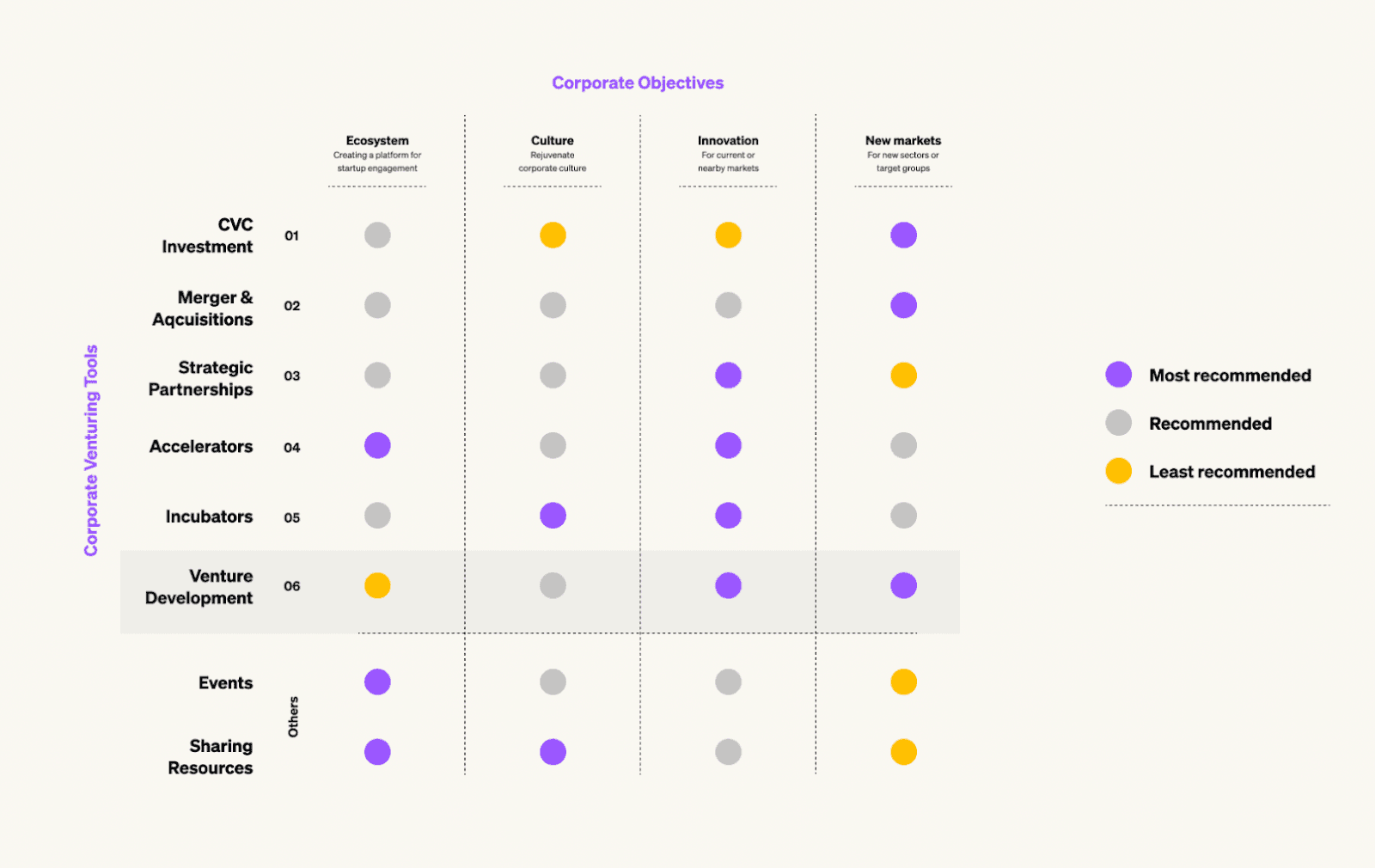
The matrix maps eight tools (CVC, M&A, strategic partnerships, accelerators, incubators, venture development, events, sharing resources) across four objectives (ecosystem, culture, innovation, new markets), showing which are most recommended for each goal.
Ecosystem
Companies seeking an ecosystem objective need tools that create an effective platform for startup engagement. Accelerators and events are the strongest fit; sharing resources and CVC also support this goal.
Culture
To build a startup mindset inside the organisation, choose tools that rejuvenate corporate culture. Incubation and sharing resources are most recommended; events also support culture goals.
Innovation
For adjacent-market innovation, choose tools suited for incremental change. Venture development studios are the strongest fit; strategic partnerships, incubators, and accelerators are also recommended.
New markets
Ready to go outside your core business? CVC investment, M&A, and venture development studios are most recommended for reaching new sectors or target groups.
Corporate venture vs independent startup: what's the difference?
A corporate venture is a new business built by an established company using its assets, brand, and capital. An independent startup raises external capital and builds from nothing. The differences show up in four places: resources, decision-making, talent and culture, and how success gets measured.
Corporate ventures and independent startups share many characteristics — like rapid innovation and agile development — but operate in fundamentally different ways.
| Corporate venture | Independent startup | |
|---|---|---|
| Resources and infrastructure | Access to parent company funding; established distribution channels and customer base; strong brand recognition and credibility; existing supplier relationships and partnerships; enterprise-level technology and tools | Limited initial resources and bootstrapped operations; need to build everything from scratch; must establish credibility and brand presence |
| Decision making | Access to corporate expertise and senior advisory networks; structured decision-making with clear accountability; governance framework aligned to parent company strategy | Fully autonomous decision-making; fast pivots with no sign-off layers; decisions driven entirely by founders and investors |
| Talent and culture | Mix of corporate and startup talent; hybrid culture combining both worlds; competitive compensation packages; career development opportunities; access to corporate expertise | Purely entrepreneurial team; startup-focused culture; equity-based compensation; high autonomy and responsibility; build expertise over time |
| Success metrics | Strategic value creation; market learning objectives; brand enhancement; capability development; long-term growth potential | Revenue and user growth; market share capture; investor returns; valuation increases; exit opportunities |
Corporate venturing examples
Verizon built Visible, a digital-first carrier launched in 2018. Disney built Disney+, launched in 2019. PepsiCo built PantryShop, taken from concept to live in under 30 days. Amazon bought One Medical to enter primary care. Each shows a different model in practice.
1. Verizon's Visible
Headquarters: US
Industry: Telecom
Founded: 2018
Visible is a digital-first wireless carrier offering unlimited data, minutes, and messaging services for a flat monthly fee — no physical stores, contracts, or hidden fees. Through research and co-creation with customers, Verizon created Visible as a separate venture that:
- Reaches new customer segments with a digital-native approach
- Operates with startup agility while using Verizon's infrastructure
- Creates direct customer relationships through D2C channels
- Provides valuable insights about digital-first service delivery
- Competes effectively in the growing digital carrier market
2. Disney+
Headquarters: US
Industry: Digital Entertainment
Founded: 2019

Disney+ is a direct-to-consumer streaming service that transformed how Disney delivers entertainment to its global audience. Building Disney+ as a venture enabled Disney to:
- Build direct relationships with consumers, bypassing traditional distribution channels
- Test new content delivery channels and user experience
- Compete effectively with tech-native streaming services
- Create new revenue through subscription-based models
The platform also provides valuable insights into viewing habits and customer preferences.
3. PepsiCo's PantryShop
PantryShop enables users to order snack kits with PepsiCo products including SunChips, Quaker Oats, Gatorade, and Tropicana. The kits come in categories from Rise & Shine to Workout & Recovery, with free shipping and mobile-optimised checkout. The initiative went from concept to live in under 30 days, using PepsiCo assets: know-how, inventory, customer insights, and technology.
Key takeaway: PepsiCo identified a customer access problem and created a direct supply channel in response. The D2C model provided a low-resource structure for meeting customer needs more efficiently.
4. Amazon's One Medical
One Medical is a membership-based primary care platform combining in-person care with digital health services. For $199 annually, members get same-day appointments, 24/7 virtual care, and a seamless digital experience for booking and health records.

By acquiring One Medical, Amazon entered healthcare using a buy model — gaining a proven capability immediately and applying its customer experience expertise to transform how people access primary care.
Key takeaway: This is the buy model in practice. Amazon bypassed years of healthcare infrastructure build time and gained direct consumer access on day one of the acquisition.
For more examples across every model, see our 50 corporate venture examples.
What are the benefits of corporate venturing?
Corporate venturing gives established companies six things their core business struggles to produce: speed, growth outside the core, market intelligence, high upside at controlled risk, entrepreneurial talent, and a position in the wider innovation ecosystem. It works because a venture can move without the parent's governance load.
Corporate venturing is the key to speeding up innovation and financial growth in a rapidly changing market driven by disruptive startups. Here are the main benefits:
1. Speed
Large corporations tend to be constrained by long chains of command and slow-moving decision-making processes, especially when it comes to out-of-the-box changes. This makes it challenging for them to innovate at the same speed startups do. Corporate venturing enables large companies to explore new opportunities with the same flexibility, autonomy and agility as startups.
2. Non-core growth opportunities
Many promising ideas in corporations are written off as "irrelevant because it's not our core business." This leaves companies clinging to outdated offerings that could soon be made irrelevant by disruptive startups. Corporate venturing enables companies to explore new growth spaces, create new revenue streams and use new technologies to compete more effectively.
3. Strategic market intelligence
Exploring new growth opportunities yields valuable insights about existing or emerging markets. This direct market engagement creates a continuous learning loop that helps companies anticipate change rather than react to it:
- Better understanding of evolving customer needs and behaviours
- Identifying potential disruption threats to the core business early
- Building an ecosystem of innovative startups and potential partners
- Testing new technologies and business models in real market conditions
4. High rewards with low risks
Launching corporate ventures enables companies to test new ideas in a lean, controlled setting. This is considerably less risky than testing a new concept, technology or business model company-wide. Ideas that work can be rapidly scaled, and those that fail can be shut down with no real damage to the parent business.
5. Talent and capability development
Companies that engage in corporate venturing tend to appeal to entrepreneurial-minded talent, attracted to fast-paced environments where creativity and resourcefulness are valued. The process of exploring and experimenting with new technologies and business models also enables companies to develop new skills and expertise.
6. Ecosystem building
Corporate venturing enables companies to build and participate in powerful innovation ecosystems that extend far beyond traditional industry boundaries. By actively engaging with startups, accelerators, and other innovation players, companies can:
- Access cutting-edge technologies and expertise
- Form strategic partnerships with emerging players
- Tap into new talent pools and ideas
- Share risks and resources across partnerships
This helps companies move from isolated players into connected innovation hubs, creating multiple pathways for growth.
What are the challenges of corporate venturing?
Five challenges come up repeatedly: choosing the right venture, balancing venture speed against corporate governance, getting the incentives right, managing customer data, and positioning the venture in an ecosystem. Each has a practical fix, and most can be designed out before the venture launches.
When it comes to corporate venturing, it is important to anticipate the bottlenecks and have ways to overcome them. Here are the most common corporate venturing challenges and their solutions:
Challenge 1. Choosing the right venture
Many corporations have trouble identifying the right criteria to choose their ventures. This will inevitably lead to difficulties down the road, like not getting the expected returns or not using the right tools to develop the venture.
The solution:
A good rule of thumb is to make sure your venturing arm is laser-focused on the company's long-term growth goals, targets and resources. Build your decision criteria based on the corporate assets you can use as an unfair advantage.
Challenge 2. Balancing venture speed and corporate governance
Corporate assets like partnerships, expertise, and funding are vital for any successful corporate venture because they give you an advantage over competitors. The problem is that it is not always easy to use these assets at the speed required by a startup. Corporate governance delays can cause the new venture to lose momentum and miss growth targets.
The solution:
Get ahead of this challenge with proper planning and communication. A venture board also helps, operating as a layer around the team to ensure their success without slowing them down.
Challenge 3. Using the right incentives
Successful ventures require a leadership team that is resourceful, driven, motivated and entrepreneurially minded. Many corporations struggle to find the right incentives, which can be detrimental to the venture's long-term success.
The solution:
Incentivise your leadership team with the right legal entity setup and personal incentives. Use KPI-driven bonus models or offer equity shares.
Challenge 4. Managing customer data
Customer data is an extremely valuable resource. When used effectively, it can help you customise your offerings, improve your customer experience, increase sales, and add useful features to existing products. The challenge is that even with all the available technology, collecting, analysing and securing it remains difficult.
The solution:
Know what you want to achieve with your data
Link your data strategy directly to your business objectives. Each objective you set at any phase must be measurable.
Make security a priority
According to IBM Security, the average cost of a company data breach globally now exceeds $4 million. Protect your data by using a CRM, CDP, or DMP; investing in a data backup system; and ensuring employees are trained on data handling and GDPR compliance.
Make sure your data is updated and accurate
Customer databases can quickly become cluttered, outdated and incomplete, leading to inaccurate conclusions during analysis. Take steps to keep them clean.
Challenge 5. Ecosystem positioning
A business ecosystem is a set of companies that complement each other by supplying products, combining offerings to create new value, or providing different ways to reach customers. It can be hard for new ventures to position themselves and connect to these complementary networks.
The solution:
Figure out what goals best fit your company's capabilities — accelerate growth, create new offerings, or build end-to-end solutions. Then establish the right strategic partnerships and bring in the entrepreneurial talent needed to move your agenda forward.
Corporate incubator or single venture: where should you start?
Build a single venture if you have little venturing experience. Build an incubator if you already have it. A single venture hits real milestones faster and teaches through doing. An incubator creates a repeatable pipeline but needs existing capability to work.
Many companies start their corporate venturing journey either by building a single venture or by setting up a venture building machine — a corporate incubator. Here is how they differ:
Corporate incubation
Corporate incubators operate within a corporate setting, using internal assets, talent, networks and other resources to support intrapreneurs in building new ventures from scratch. The incubator approach creates a framework or program to build a pipeline of new ventures.
Single venture build
Instead of building a program, this approach focuses on building a single venture. Teams can immediately cut to the chase, learning as they go and hitting actual milestones faster (MVP, launch, scale). It enables teams to start small and gain insights through direct experience.
| Corporate incubator | Single venture build | |
|---|---|---|
| Advantages |
|
|
| Disadvantages |
|
|
If your company has a range of entrepreneurial experience, starting an incubator is probably the right way to go. Ask yourself:
- Does your company have any corporate venturing experience?
- Does anyone on your team have experience working with startups?
- Is there currently any type of venturing process in place (e.g. M&A)?
- Have you developed any internal innovation projects?
The more "YES" answers, the stronger the case for starting with an incubation program.
How do you set up governance, funding, and the legal entity?
Three decisions: governance, funding, and legal entity. Governance sets who decides what, usually through a venture board and a venture team. Funding can be internal, external, or hybrid. The legal entity is normally a business unit, a spin-off, or a joint venture, chosen by distance from the core.
A crucial part of ensuring the success of your ventures is to identify and establish the right governance, funding, and legal setup — a triad that serves as the backbone of their operations.
Choosing the right governance structure
Governance structures help you navigate the balance between autonomy and control. It is the framework that outlines the decision-making process and how your venture is run. Elements of a strong governance framework include:
- Clear roles and responsibilities for the venture board and management team
- Policies and procedures that guide decision-making
- Regular review and updating of your governance framework
In most cases, you will need a setup that includes:
- A venture board: corporate sponsors that provide strategic advice and unblock access to parent assets
- A venture team: developers, creatives and experts that execute ideas
Choosing the right funding setup
Funding is the lifeblood of any business. Here are the main options:
- Internal funding: Allocating corporate parent capital to finance the venture.
- External funding: Raising capital from outside sources — VCs, banks, or partners.
- Hybrid funding: Combines both, offering a more balanced approach and enabling a spin-off structure to raise externally in a way a business unit cannot.
Choosing the right legal entity
Finding the right legal entity setup will have a crucial impact on your venture's success and how fast it reaches profitability. The three most common options for companies expanding past their core activities are business units, spin-offs, and joint ventures.
| Business unit | Spin-off | Joint venture | |
|---|---|---|---|
| What it is | A fully functional unit with its own vision and direction, operating as a separate entity while remaining part of the parent company's legal structure | A new company created from an existing one (e.g. through a subsidiary). Has its own assets and distinct business operations no longer under the parent company's direct control | Two or more companies pooling their resources and expertise to achieve a common goal — each contributing specific resources in exchange for a share of revenues and control |
| Distance from core | Closest to core | Furthest from core | Shared — between partner companies |
| Best when | The venture is close to the core business and relies heavily on parent assets | The venture is far from the core and needs full operational independence | Two companies bring complementary assets and share the risk and reward |
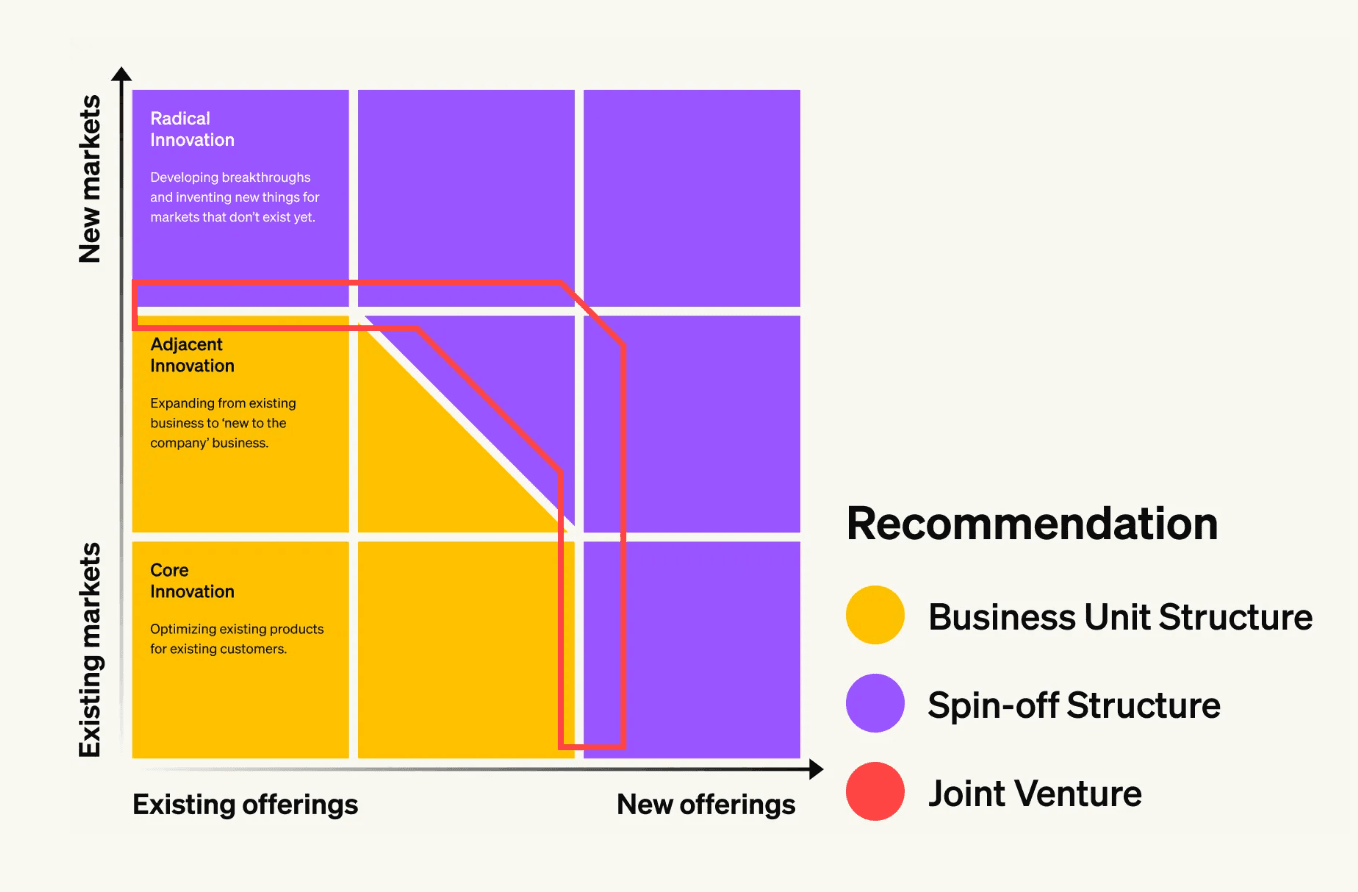
The innovation matrix maps three zones to the right legal structure: core innovation (optimising existing products for existing customers) suits a business unit; adjacent innovation (expanding to new-to-company business) can work as a business unit or spin-off; radical innovation (new markets, new offerings) suits a spin-off or joint venture. The rule: the further the venture sits from the core, the less it relies on core assets, and the stronger the case for a spin-off.
How do you measure a corporate venture?
Metrics should change by stage. Early stages measure problem-solution fit and market potential. Later stages measure scalability and profitability. Six mistakes recur: over-relying on quantitative measures, misaligning with strategy, treating metrics as targets, ignoring the long term, failing to capture intangibles, and comparing unlike ventures.
Each phase of your venture journey has its own unique set of challenges and goals, and your metrics should reflect that.
| Stage | What you are testing | Metrics to track |
|---|---|---|
| Discover | Corporate value space fit — a validated value proposition | Market size, buyer intent, corporate leverage |
| Pilot | Problem-solution fit — validated demand with an MVP | Acquisition & retention, monetisation, feasibility |
| Launch | Product-market fit — positive and sustainable unit economics | LTV & CAC, cost structure, operational efficiency |
| Scale | Product-channel fit — exponential growth | Market penetration, economies of scale, MoM/YoY growth |
| Venture maturity | Sustained performance | Time to value, churn rate, NPS |
Tailoring your metrics to your venture activities will help you make smarter decisions about resource allocation, manage risks more effectively, and communicate progress to stakeholders in a way that makes sense for each stage.
Here are the most common challenges companies face when selecting metrics, along with tips to avoid them:
An over-reliance on quantitative metrics
Quantitative metrics are crucial for their objectivity and ease of tracking, but they can overlook nuanced outcomes like strategic alignment or customer satisfaction.
How to avoid it: Use a balanced scorecard that includes both quantitative and qualitative metrics — complement financial return metrics with regular stakeholder surveys or case studies.
Misalignment between metrics and strategic goals
Metrics should directly reflect the strategic objectives of both the venture and the parent company. Misalignment can lead to pursuing ventures that appear successful on paper but do not contribute meaningfully to long-term goals.
How to avoid it: Review and align metrics regularly with corporate strategy. Involve key stakeholders from various departments in the metric selection process.
Using metrics as targets
When metrics are treated as targets, there is a risk of focusing on them too narrowly at the expense of broader objectives.
How to avoid it: Use a diverse set of metrics and avoid tying compensation too closely to any single one. Regularly review and update your metric set.
Balancing short-term and long-term
Corporate venturing often involves initiatives that will only show their full potential in the long run. Relying heavily on short-term metrics can cut off promising opportunities prematurely.
How to avoid it: Use milestone-based metrics for long-term projects and pair them with short-term operational efficiency metrics.
Quantifying intangibles
Many corporate ventures aim for strategic benefits — gaining market insights, developing new capabilities — which are crucial but hard to measure quantitatively.
How to avoid it: Develop proxy metrics or qualitative assessment frameworks. Track the number of insights shared across the organisation, or use capability maturity models.
Comparing apples to oranges
Different ventures often have vastly different goals, timelines, and contexts, making standardised comparisons challenging.
How to avoid it: Use tailored, context-specific metrics for different types of ventures rather than applying a single standard framework across all.
Why do corporate ventures fail?
Corporate ventures fail for the same reasons startups do: thin funding, mismatched teams, weak validation, and poor go-to-market. Corporate ventures have a higher success rate because they draw on parent assets, but they are not immune. The fix is keeping losses small through continuous lean validation.
New businesses fail for various reasons:
- Lack of funding
- Incompatible teams
- Inadequate validation and proof
- Inadequate marketing
Even corporate ventures, which have a significantly higher chance of success due to the smart use of corporate assets, are not immune — and there are plenty of examples to prove it.
The good news is that each failure delivers an array of insights, strengthening your company's capabilities, knowledge and expertise and helping you avoid detrimental mistakes in the future. The trick is to keep your losses controlled and small by constantly validating various elements using lean experimentation techniques. This approach allows you to fail forward and gain the insights needed to make key decisions: iterate, pivot, or kill it.
Where to start
Corporate venturing is a cost-efficient way to accelerate growth, create new revenue streams and build capabilities that your core business cannot develop at startup speed. It requires careful planning and an entrepreneurial mindset — but working with the right tools, techniques and partners significantly reduces the risk.
- Identify your objective first — ecosystem, culture, innovation, or new markets
- Match the model to the goal — build, buy, partner, or invest
- Set up governance, funding, and legal structure before you start building
- Choose your metrics by stage, not by what is easiest to measure
- Validate continuously and keep losses small
For more insight from practitioners, read what four leading innovation experts had to say about governance, agile organisations, targets, KPIs, and the definition of corporate venturing.
Join the Bundl Venture Club
Access exclusive research, templates, and a community of corporate venturing practitioners. The fastest way to go from reading to doing.
Corporate venturing FAQ
What is corporate venturing?
Corporate venturing is how an established company pursues growth through startups rather than only through its core business. It covers four models: building new ventures, buying them through M&A, partnering with them as an early customer, and investing through corporate venture capital. Each trades control, cost, and speed differently.
What is the difference between corporate venturing and corporate venture capital?
Corporate venturing is the umbrella term for every way a company engages with startups. Corporate venture capital is one model within it, where the company takes a minority equity stake in a startup that already exists. All CVC is corporate venturing. Not all corporate venturing is CVC.
What are the main types of corporate venturing?
Four. Building creates a venture from scratch, usually through a venture studio or corporate incubator. Buying acquires a company through M&A. Partnering uses a startup as a customer or channel, often through a venture client unit. Investing backs an external startup through corporate venture capital.
What is the difference between a corporate venture and a startup?
A corporate venture is built by an established company using its assets, brand, and capital. An independent startup raises outside capital and builds from nothing. The practical differences show up in resources, decision-making speed, talent and culture, and how each defines success.
Which corporate venturing tool should we use?
Start with the objective. Ecosystem goals suit accelerators and shared resources. Culture change suits incubation. Adjacent-market innovation suits partnerships and venture studios. Moving outside the core suits CVC, M&A, and venture studios. Then filter by budget, risk appetite, and time horizon.
How do you fund a corporate venture?
Three options. Internal funding allocates parent capital. External funding raises from VCs, banks, or partners. Hybrid funding combines both. The choice interacts with your legal entity: a spin-off can raise externally in a way a business unit cannot.
Who should own a corporate venture inside a large company?
Most working setups have two layers. A venture board of corporate sponsors provides strategic direction and unblocks access to parent assets. A venture team of builders, designers, and commercial leads executes. Keeping those separate is what stops corporate governance from slowing the venture down.
How do you measure a corporate venture?
Match metrics to stage. Early on, track problem-solution fit and market potential. Later, track scalability and profitability. Avoid treating metrics as targets, and pair short-term operational measures with milestone-based ones so long-horizon ventures are not cut early.