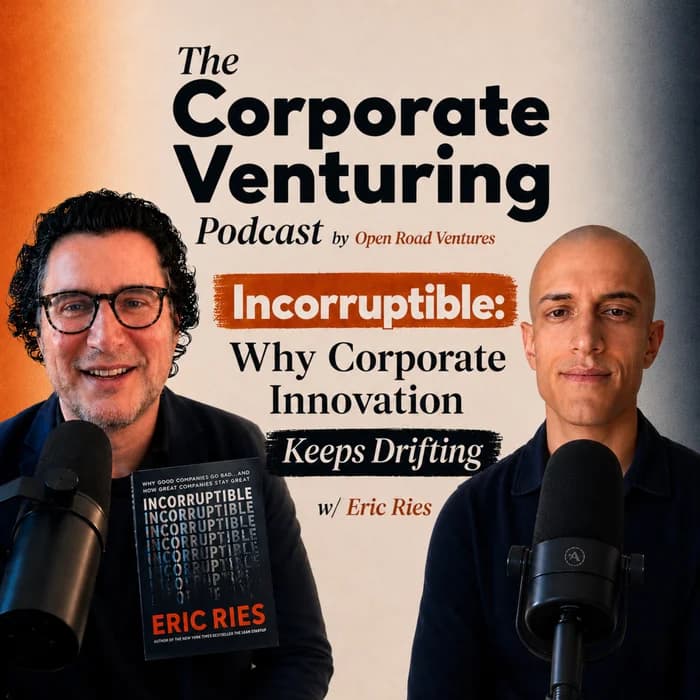
Incorruptible: Why Corporate Innovation Keeps Drifting
Eric Ries, creator of the Lean Startup, on why companies quietly lose what made them good, and why that is a design problem rather than a moral one.
With Eric Ries
From The Corporate Venturing Podcast, brought to you by Open Road Ventures
4 things this conversation gets into
- 01How FedMart lost the trust it spent 20 years building, and how Costco was born
- 02Financial gravity: the force shaping middle management decisions
- 03The culture bank, and why trust compounds like a financial asset
- 04Governance that protects a founding ethos from short-term pressure
Eric Ries is the creator of the Lean Startup method, founder of the Long-Term Stock Exchange and author of Incorruptible. He spent 20 years watching companies he helped build get quietly dismantled, and diagnoses corporate corruption as a design problem he calls financial gravity.
Davide Ritorto is a management engineer from Italy with an international MBA, currently working at Lamborghini. He is what some call an intrapreneur, passionate about open innovation and corporate venturing, and driven by curiosity about how things work and how to make them work even better. Through Open Road Ventures he sets out to inspire and inform other innovators, intrapreneurs and dreamers.
He founded Open Road Ventures as a weekly publication on open innovation and corporate venturing, and The Corporate Venturing Podcast grew out of it. He also mentors startups at Motor Valley Accelerator and sits on the Open Innovation Advisory Board at UC Berkeley Haas.
The Corporate Venturing Podcast is made by Open Road Ventures. The Bundl Venture Club is a partner of the show.
Read the full show notes
In this episode, I'm joined by Eric Ries, creator of the Lean Startup method, founder of the Long-Term Stock Exchange, and author of Incorruptible.
Eric spent 20 years watching companies he helped build get quietly dismantled. His diagnosis: corporate corruption is a design problem. The system itself was built to pull organizations toward short-termism. He calls it financial gravity. Nobody ordered it. It just happened, because the structure made it inevitable.
In this episode, Eric shares insights on:
⚖️ Why FedMart was destroyed by the exact customer trust it spent 20 years building, and the A/B test that produced Costco
🏛️ The governance fortress Jim Sinegal built at Costco to protect Sol Price's ethos from investors, and why it still holds 40 years later
🧲 Financial gravity: the unconscious force shaping middle management decisions before any leader notices
👁️ Mary Parker Follett's invisible leader (1920) and why the most consequential decisions get made when no manager is in the room
🏦 The culture bank: why trustworthiness compounds like a financial asset, and why intentional withdrawals are always an error regardless of short-term ROI
💡 Why Eric redefines profit as the maximization of human flourishing, and what that means for the Groupon-style decisions corporate teams face every quarter
We close on one concrete action: adopt the culture bank rule. Clay Christensen said doing the right thing 100% of the time is easier than 98%, because you never have to have a meeting about it.
Resources:
- Open Road Ventures Newsletter
- Incorruptible — Eric's new book
- The Eric Ries Show Podcast
- Eric Ries Newsletter
- Eric Ries on LinkedIn
- Eric Ries on X
🎧 Follow the podcast for grounded conversations on what actually shapes innovation and corporate venturing — beyond the frameworks, beyond the hype.
Keep listening
All episodes

New growth plays, every fortnight.
What is working inside the world’s biggest consumer brands, straight to your inbox.